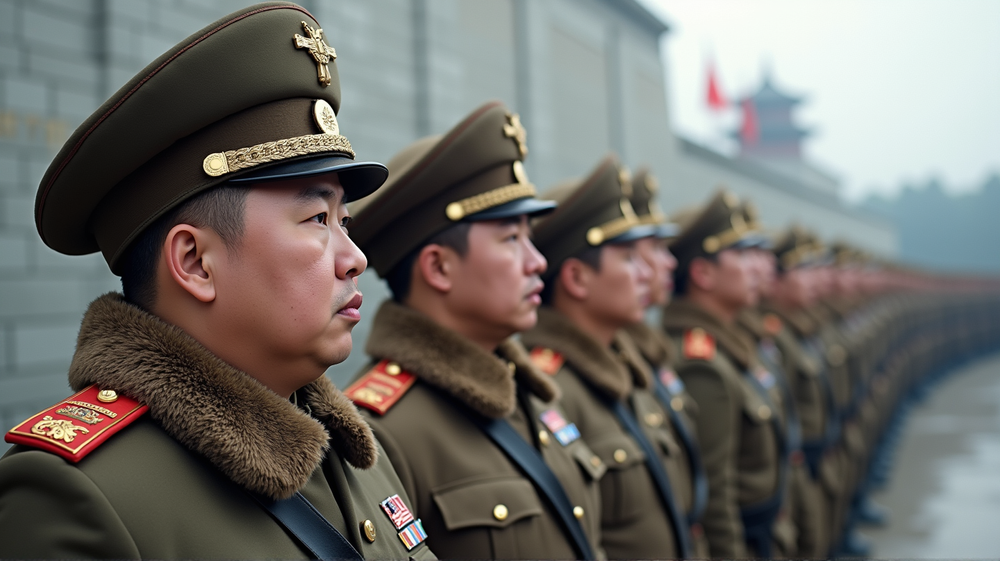
North Korea's Bold Bet: Sacrificing Economic Gains for Military Advancement
In a move that seems to prioritize military prowess over economic potential, North Korea has chosen to focus on obtaining advanced weapons technology from its involvement in the Ukraine conflict, rather than reaping economic benefits. As stated in DailyNK, Kim Jong Un’s regime is speeding up the construction of a memorial and cemetery in the Hwasong district for soldiers who died fighting in Ukraine, highlighting its emphasis on military achievement.
Prioritizing Military Memorials over Economic Profits
Satellite images reveal rapid construction in Pyongyang’s Hwasong district, with a memorial and cemetery dedicated to fallen North Korean soldiers. This construction marks the regime’s decision to use military advancements from Russia as a leverage point, prioritizing defense over possible economic returns.
The Cost of Commitment
The decision to focus on military cooperation means forfeiting economic profits that could have been gained through participation as a belligerent with Russia. Historical examples show how nations like Japan and South Korea benefited economically from wars in Vietnam and Korea, bolstering their post-war economies. North Korea, however, has chosen a different path.
Construction Underway: A Monument to Loss
Since the groundbreaking on October 23, 2025, a three-story structure has rapidly taken shape. The memorial includes statues, an arched entrance, and walls detailing the accomplishments of the deceased soldiers. Expected to be complete by early 2026, it underscores the emphasis on national military pride over fiscal gains.
A Missed Economic Opportunity
While South Korea profits from rising armaments demand, particularly in Asia and Northern Europe, North Korea’s potential economic prospects remain muted. The decision to prioritize technological exchanges from Russia places economic concerns in the backseat while it enhances its military capabilities.
Strategic Focus on Technology
In opting for cooperation on military technology over economic benefit, North Korea underscores its commitment to the military-industrial complex. This choice is driven by an enduring focus on technological advancement to preserve the regime, demonstrating that economic welfare concerns are secondary to military enhancement.
Although cooperation with Russia provides technological advances, it leaves the everyday welfare of North Koreans largely unchanged, with economic challenges and elevated living costs persisting without relief.
The choice made by Kim Jong Un’s regime reflects a strategic decision to fortify military might through technological means, despite the global trend to capitalize economically from participating in international conflicts.